XGIMI is now shipping its $1,499 Horizon 20 Pro projector in a Christmas box for gift buyers.
Nov 28, 2026
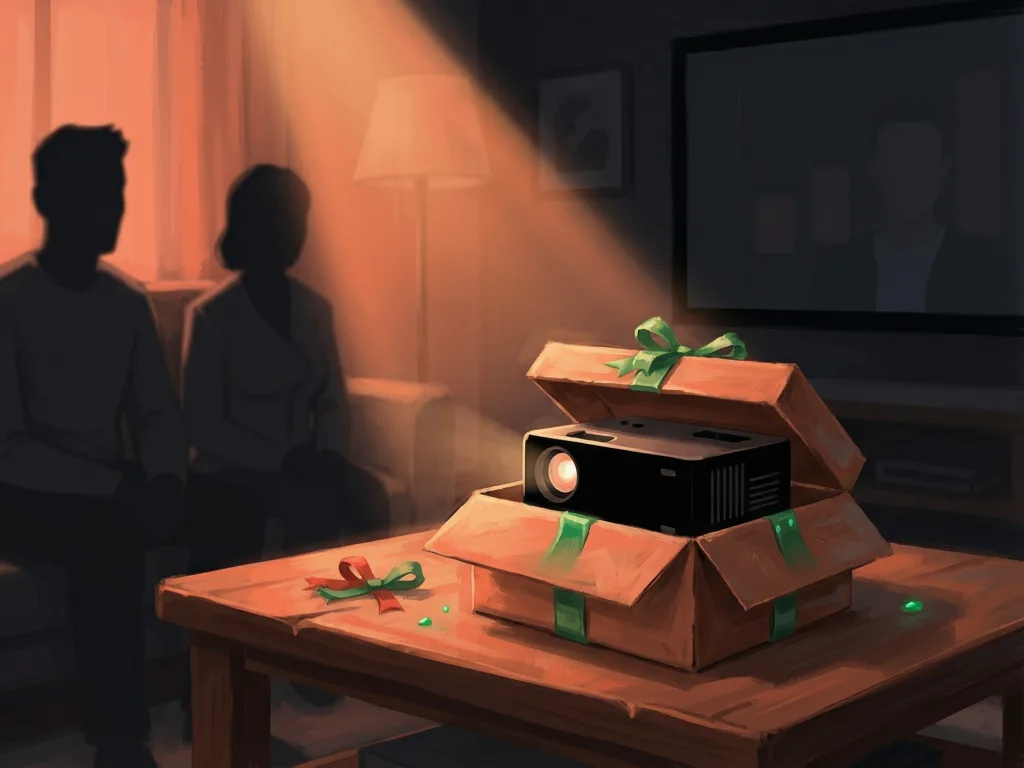
XGIMI is selling the Horizon 20 Pro Holiday Edition in the US for $1,499. The projector itself is the same 4K RGB triple laser model as the regular Horizon 20 Pro; the difference is the packaging. It ships in a Christmas box, which makes the product easier to gift without changing its technical content.
What the Holiday Edition Actually Changes
The Holiday Edition is not a new projector model. It is the Horizon 20 Pro with different packaging. The projector retains the same core hardware: a 0.47-inch DLP chip, native 3840 x 2160 resolution, and up to 4,100 ISO lumens of brightness. The original Horizon 20 Pro first went on sale at $2,499 when the Horizon 20 series launched at IFA 2025.
The $1,499 Holiday Edition therefore offers a lower price for the same projector hardware, if a buyer is comfortable with the seasonal box.
Why the $1,499 Price Matters
For a projector described as 4K RGB triple laser, the $1,499 price is the main reason to look at this edition. The regular Horizon 20 Pro launched at $2,499. The Holiday Edition keeps the same hardware but is sold at $1,499 in the US.
That makes it a cheaper way to get the Horizon 20 Pro’s main features, especially for buyers who do not need the newer Horizon 30 Pro’s higher brightness or 4K at 120Hz.
What You Get Inside the Projector
Inside, there are no hardware surprises compared with the regular Horizon 20 Pro. The projector uses a 0.47-inch DLP chip to produce native 3840 x 2160 resolution. For readers unfamiliar with the term, native resolution means the image is created at 3840 pixels wide and 2160 pixels high, rather than only being scaled up from a lower resolution.
Brightness is rated at up to 4,100 ISO lumens. ISO lumens is a brightness measurement that can help compare projectors using a more standard method. Higher brightness can make the image easier to see in rooms with some ambient light, although the source does not say how the Horizon 20 Pro performs in specific room conditions.
The projector supports Google TV, two 12W Harman Kardon speakers, and support for Dolby Vision, HDR10+, and IMAX Enhanced. These features are aimed at home entertainment: Google TV provides the software side, Harman Kardon speakers handle basic built-in audio, and Dolby Vision, HDR10+, and IMAX Enhanced relate to high dynamic range or enhanced picture formats.
How It Handles Gaming
Gaming is included as a feature of the package. The projector supports up to 240Hz at 1080p, with a claimed 1ms response time at that setting. XGIMI’s latency figures also include 2.2ms at 1080p/120Hz and 3ms at 4K/60Hz.
The practical point is simple: the highest refresh rate is available at 1080p, not 4K. A refresh rate tells you how many times per second the projector can update the image. A higher refresh rate can make motion look smoother in games, especially fast competitive titles. However, to use 240Hz, a buyer must accept 1080p resolution instead of native 4K. At 4K/60Hz, the listed latency is 3ms.
Placement, Picture Size, and the Lens Shift Trade-Off
Placement is fairly flexible. The projector includes optical zoom, a 1.2-1.5:1 throw ratio, and lens shift supporting plus or minus 120 percent vertically and plus or minus 45 percent horizontally. It can project images ranging from 40 to 300 inches.
For a beginner, this means the projector can be moved or adjusted in more ways than a basic projector that only changes picture size by moving closer or farther from the screen. Optical zoom changes image size without moving the projector. Throw ratio describes how much distance is needed relative to image width. Lens shift moves the image vertically or horizontally without tilting the projector.
There is one important catch: activating lens shift disables automatic keystone correction and focus adjustments. Keystone correction can fix a projected image when the projector is not perfectly square to the screen. The trade-off is that some placement convenience comes from lens shift, but once lens shift is used, automatic correction features are turned off.
Accessories, Warranty, and Installation Needs
The included accessories are fairly basic. Buyers get a power plug, a backlit Bluetooth remote with two AAA batteries, a manual, and a warranty card. There is no ceiling mount or floor stand in the box, so a buyer will need to arrange a suitable installation separately.
XGIMI includes a two-year warranty, four years of over-the-air software updates, and a 30-day money-back guarantee. Over-the-air software updates mean the projector can receive new software features or fixes without a manual update process, according to the source.
Horizon 20 Pro vs Horizon 30 Pro
The Horizon 20 Pro is no longer XGIMI’s newest generation. The company launched the Horizon 30 series on October 12, bringing a brighter and faster option with the Horizon 30 Pro.
The Horizon 30 Pro is rated at 4,800 ISO lumens and supports 4K playback at 120Hz. Its list price is $2,499, but XGIMI’s Black Friday promotion brings it down to $1,899 from November 19 to 30 on XGIMI.com and Amazon.
That leaves the older Horizon 20 Pro $400 cheaper at its current $1,499 price. For buyers who do not need 4K at 120Hz, the older model still packs plenty of hardware for the money. The comparison becomes a question of whether the extra $400 is worth the newer model’s higher brightness and 4K at 120Hz support.
Buying Details in the US
The Holiday Edition is available in the US, with prices excluding sales tax. XGIMI lists free shipping and an estimated dispatch time of one to three days. The store page currently has no customer reviews.
Related Apps





Recommend Apps